From the Column to the Cosmos: How Elon Musk found the "dud" in Nolan’s Odyssey
Elon Musk hits out at Sam Altman and Lupita Nyong’o — on the same day!

It isn’t often that the richest man on Earth takes his cues from a niche Substack dedicated to the nuances of Mycenaean history and cinematic integrity, but here we are. When the Greek Column first ran the headline “Nolan’s latest hype-fueled ‘Odyssey’ already looks like a dud,” we weren’t just being contrarian; we were being honest. Now, it seems Elon Musk has caught the scent, joining our “anti-Odyssey“ bandwagon with his signature brand of digital megaphone-blasting.
While Musk’s critique centers on the “integrity” of casting choices—specifically his fixation on Lupita Nyong’o as Helen of Troy—the Greek Column’s issues with Christopher Nolan’s $250 million behemoth go far deeper than a single casting call. Musk is looking at the face; we are looking at the soul of the work. Or rather, the lack thereof.
The “Oppenheimer” Formula, Recycled
Our original contention remains: Nolan is attempting the same sleight of hand that carried Oppenheimer to the Oscars. He is substituting character depth for a booming, Hans Zimmer-adjacent score and a non-linear timeline that serves no narrative purpose other than to gaslight the audience. If you find the jumping between the Trojan War and a “tactile-realist” Ithaca confusing, Nolan’s defenders will simply tell you that you aren’t “intellectual” enough for the medium.
In reality, it’s a gimmick to mask a vacuum. By stripping the Odyssey of its Mediterranean soul—the salt, the sea-glare, and the archaic heartbeat of the poem—Nolan has delivered a “deracinated” epic.
A King from Boston, A Language from London
Let’s talk about the “historical integrity” Musk claims to defend.
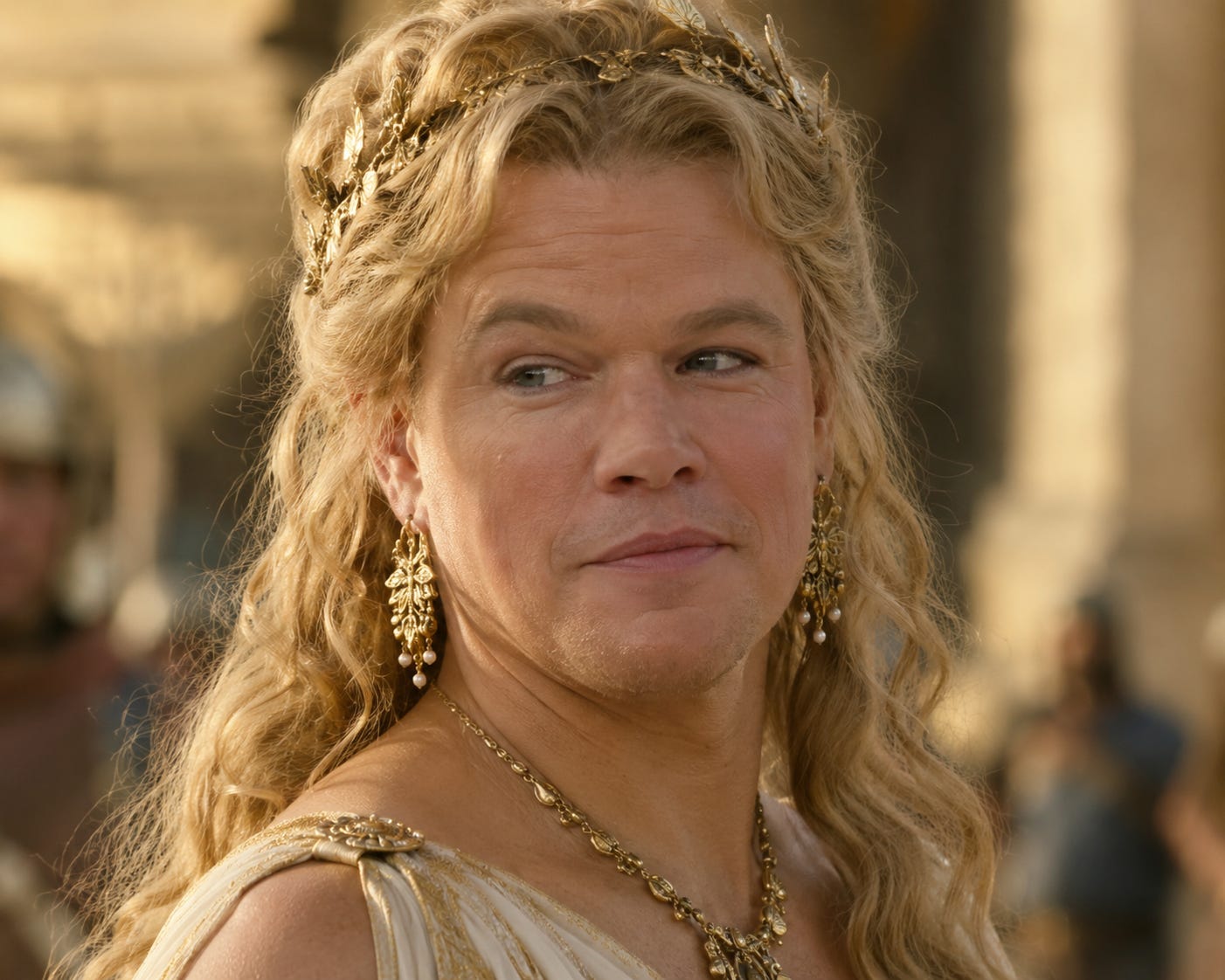
Matt Damon as Odysseus: Damon is a fine actor, but as a Greek King? He carries the weary air of a mid-level manager from South Boston rather than the “man of many wiles.” Seeing him in Mycenaean bronze while speaking in his flat American drawl feels less like Homer and more like a high-budget Halloween party.
The Linguistic Void: For a director obsessed with “realism” and “tactile” effects, the choice to have everyone speaking modern English is the ultimate surrender. If we can endure three hours of sub-bass vibrations in IMAX, we could have endured subtitles for the sake of gravitas.
The Musk Factor
Elon Musk’s recent outbursts on X (formerly Twitter) regarding the casting of Lupita Nyong’o as Helen have certainly added fuel to the fire. Musk’s argument—that casting choices must adhere to a rigid, fair-skinned interpretation of the “face that launched a thousand ships”—is the kind of fixation we’ve come to expect. While he focuses on the “woke” vs. “anti-woke” culture war, he misses the broader point we made first: the film is a structural and aesthetic catastrophe regardless of who is on screen.
Conclusion
Whether it’s Musk’s obsession with “historical matches” or our critique of Nolan’s “intellectual” bullying, the consensus is shifting. Nolan has become a victim of his own tropes. The Odyssey should be a story about a man trying to find his way home; instead, it’s a story about a director lost in his own editing suite, hoping that if he turns the volume up high enough, we won’t notice that his Greek King looks like he’s looking for a Dunkin’ Donuts in downtown Ithaca.
Nolan’s Odyssey isn’t a masterpiece in waiting. It’s a $250 million dud that forgot that at the heart of every epic is a human being—not just a loud, non-linear ego.
Because beneath the hype, the IMAX bombast, and the inevitable think-pieces declaring Nolan “our greatest living filmmaker,” The Odyssey increasingly resembles a familiar exercise in self-serious cinematic inflation.
A three-hour lecture on its own brilliance, good grief. The ancient Greeks had a word for what they did to menfolk who started punching a little higher than their stations a little too often: ostracism.