Mykonos is officially overparty. You should’ve gone to this gatekept Greek island instead.
Skip the basic influencer traps. Kea's got immaculate views, zero crowds, and a plot twist that involves literally swimming to an archaeological site.

Three hours into my solo, totally unguided vibe-check of Kea—this teardrop-shaped Greek island that literally nobody outside of Greece seems to know about—things were going downhill, fast. I thought I was being a genius by bringing my rental car onto the ferry for the 16-mile trek from the mainland port, Lavrio. Spoiler alert: I wasn’t. The moment I found out cars are banned in the hilltop village of Ioulis, where I was staying, I knew I’d miscalculated. Let me tell you, even tiny suitcases start feeling like straight-up kryptonite when you’re dragging them across cobblestone hills under a brutal, late-summer sun.
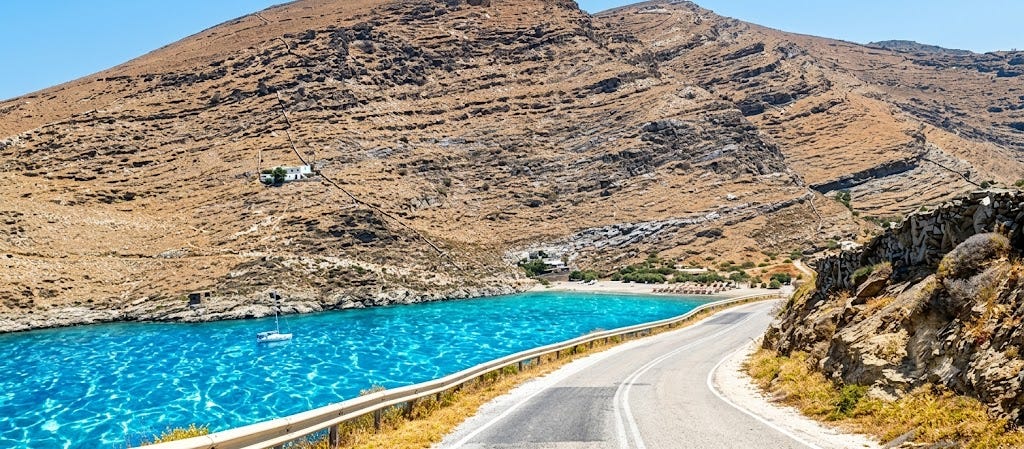
The second major L happened at a tiny village called Koundouros. From the window, I spotted this gorgeous, totally empty beach cove. I stopped the car and practically skipped over to the shore, ready to live my best main-character life in the sparkling blue water, when I was abruptly stopped by a whole squad of purple jellyfish. I’d read on the internet that these small but genuinely terrifying sea creatures were plaguing Mediterranean beaches, and yup, there they were—welcoming me to Kea with their toxic little aquatic dance and sending me sprinting back to the car. Major beach bummer.
I drove a bit farther down the southern coast, thinking a wider, open-sea beach might be a jellyfish-free zone. Things were looking up, until I got stuck behind a massive truck loaded with hay. Like, more bales of hay than you’d ever expect a tiny Greek island to produce. The lane was so narrow it was literally impossible to pass. My only option? Drive in reverse on a clifftop dirt road with zero guardrails. The lack of a safety net really added to the fun/misery.
But honestly, the history here is kind of iconic. Kea is the westernmost Cycladic island and the closest to Athens. Back in antiquity, it was called Tetrapolis (which means “four cities,” because it was running a whole four-city federation vibe). It has a long, rich history, even if it gets completely eclipsed by influencer-heavy islands like Delos—the mythological birthplace of Apollo that sits right across from Mykonos. Apollo’s son, Aristaios, literally lived here, alongside a bunch of ancient VIPs. One of them was Baccylides, a famous lyric poet who came from the exact town where I couldn’t park. He wrote some pretty legendary bars, like: “At Marathon the Athenians, the bastion of the Greeks, laid low the might of the gold-bearing Persians.” High-key poetic energy.
The island also hosted Simonides, another legendary poet, and Prodicus, a philosopher who basically invented early linguistics. Back in the Bronze Age, Kea was home to Ayia Irini, a massive port city that was trading with the Minoans and Mycenaeans way before Athens was even a big deal. Later, during the Middle Ages, the Byzantines built over it, and the Venetians took over in the 1200s, building a castle right on top of the ancient acropolis in Ioulida.
But after my humiliating beach retreats, I wasn’t thinking about medieval castles; I wanted to find the archaeological ruins. Specifically, the ancient theater and temple at Karthaia on the southeast coast. The site is wrapped in total mystery, dating back to around 1130 B.C. when Ionian Greeks first settled the island. The issue? Neither Google Maps nor Apple Maps knew how to get there. I finally found the trailhead, but it was so long. With absolutely zero signs of life except buzzing bees and a scorching wind, I realized I definitely didn’t have enough water for this side-quest.
This island is super parched during this time of year, but it’s packed with well-marked hiking trails. It’s entirely anti-touristy and hotels are rare—which is exactly why wealthy Athenians and rich Israelis low-key buy secret summer homes here to escape the crowds. It’s an easy trip from the mainland but feels totally isolated. It’s not “user-friendly” like Capri, but it has this moody, beautiful aesthetic. Honestly, it’s the Greek equivalent of Nantucket.
After failing to get close to the island’s good side, I decided to head back to the port, find a café with solid Wi-Fi, and check the ferry schedules. Kea was a bit too gatekept for my liking. I figured I’d take a few photos, dodge some more jellyfish, and ferry back to more familiar shores. The ship (Goutos Lines) was solid, and making paperless tickets on your phone is incredibly easy. You can just buy an ice cream on board and vibe while the sea breeze hits your face.
But then, the plot twisted. I was looking at an outdoor exhibit about Kea’s maritime past when I read about Lambros Katsonis, an 18th-century Greek revolutionary hero. During the Russo-Turkish War, he was trapped in Kea’s harbor by an Ottoman fleet. Instead of giving up, this absolute madman had his crew drag their entire ships across a narrow strip of dry land to the open sea, completely bamboozling the Turkish fleet who were waiting for him at the harbor entrance. This legendary escape happened right near where I was standing.
That’s when it hit me: I’d been doing it all wrong. The proper way to experience an island isn’t by land—it’s by sea. Bye-bye dysfunctional hiking ideas, hello boat captain. I found Captain Petros down by the harbor, walking with that effortless main-character energy only sea captains have. I asked if he could take me to the Temple of Karthaia by boat. He told me it wasn’t a typical request, but the water was calm, so he gave me the green light.
Wow, a little water changes literally everything. I climbed onto his sleek motorboat—his wife was already chillin’ on board—and we zoomed past the mega-yachts and out of the port. The view of the white villas perched on the sunburnt mountains was immaculate. The suffocating heat of the roads evaporated, and the sea breeze absolutely slayed. What could be better?
Jumping in the water, obviously. “I have a surprise for you,” the captain shouted over the engine. “Look left.” He pointed to a barren hill featuring the ultra-luxury One&Only Kea Island resort. I could already see the main attraction: dazzling, crystal-clear blue water in a secluded cove, and—thankfully—not a single jellyfish in sight. He cut the engine and told me to jump in.
After a quick swim, we pushed through some choppy waters past Schinos Bay to the coast right outside ancient Karthaia. From the boat, we could see the temple ruins—looking exactly like the off-white columns of the Parthenon—sitting high on a bluff, with a remarkably intact ancient theater down below. There was nowhere to dock, though. “You’ll have to swim,” Captain Petros said. “But don’t worry, we’ll wait.”
He handed me a waterproof dry bag for my phone and a bottle of water, and I dove straight into the deep blue. The few hikers who had actually made the long, dusty trek to the beach looked completely startled when I casually swam ashore and started hiking up to an ancient temple in nothing but my swim trunks.
Even with that magnificent view of ancient pillars and mountain peaks, I didn’t stay long. The Kean sea was calling too loud, and honestly, you don’t keep your new Greek sea captain waiting. Right?