The Great Aegean Drag Race: Why You Should Stop Sprinting to the Greek Islands
Before you blow your entire vacation budget on a high-speed catamaran, consider the subtle, civilized joy of arriving two hours later with your lunch money intact.

We seem to have a collective malady in modern travel: the obsession with saving time we don’t actually know what to do with. You see it at every boarding gate, and you certainly see it at around 6:30 AM at the Port of Piraeus, where frantic vacationers chug scalding espressos (doncha know the Greeks take it iced, iced, baby?) desperate to rocket across the Aegean Sea at Mach 3.
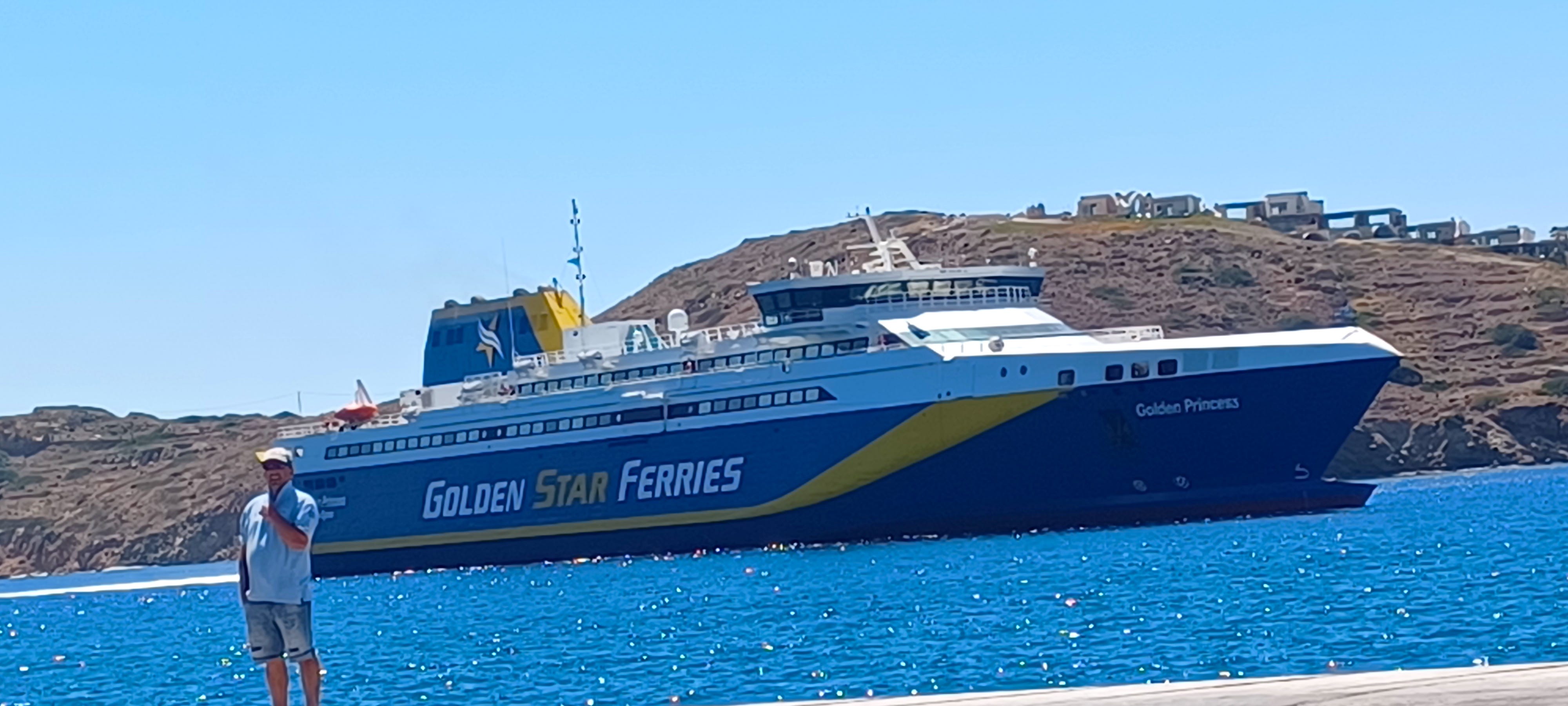
Enter the sleek world of the high-speed catamaran. Companies like Seajets offer marvels of modern marine engineering, cutting through the water like carbon-fiber blades. Take their 7:00 AM departure, the Olympic Champion Jet. It screams out of Piraeus and drops you in Mykonos by 9:40 AM. That is undeniably fast. It also undeniably costs around $92 per person—one way, without a car (add about $100 more per car).
But let’s pause and look just a few berths over. There floats a majestic, traditionally built behemoth of the Blue Star Ferry line, perhaps the Blue Star Mykonos or the massive Blue Star Delos. She departs at 7:15 AM and pulls into Mykonos at 11:55 AM. Yes, you read that correctly: you arrive a grand total of two hours and fifteen minutes later. But the ticket? A cool $50. That’s almost half the price
Unless you have an emergency meeting with a VIP beach club cabana at 10:00 AM, what exactly is the rush? You are still arriving well in time for a long, wine-soaked Greek lunch. And those extra forty-two dollars stay firmly in your pocket, where they can be properly reinvested in several rounds of refreshing local beers and souvlaki.
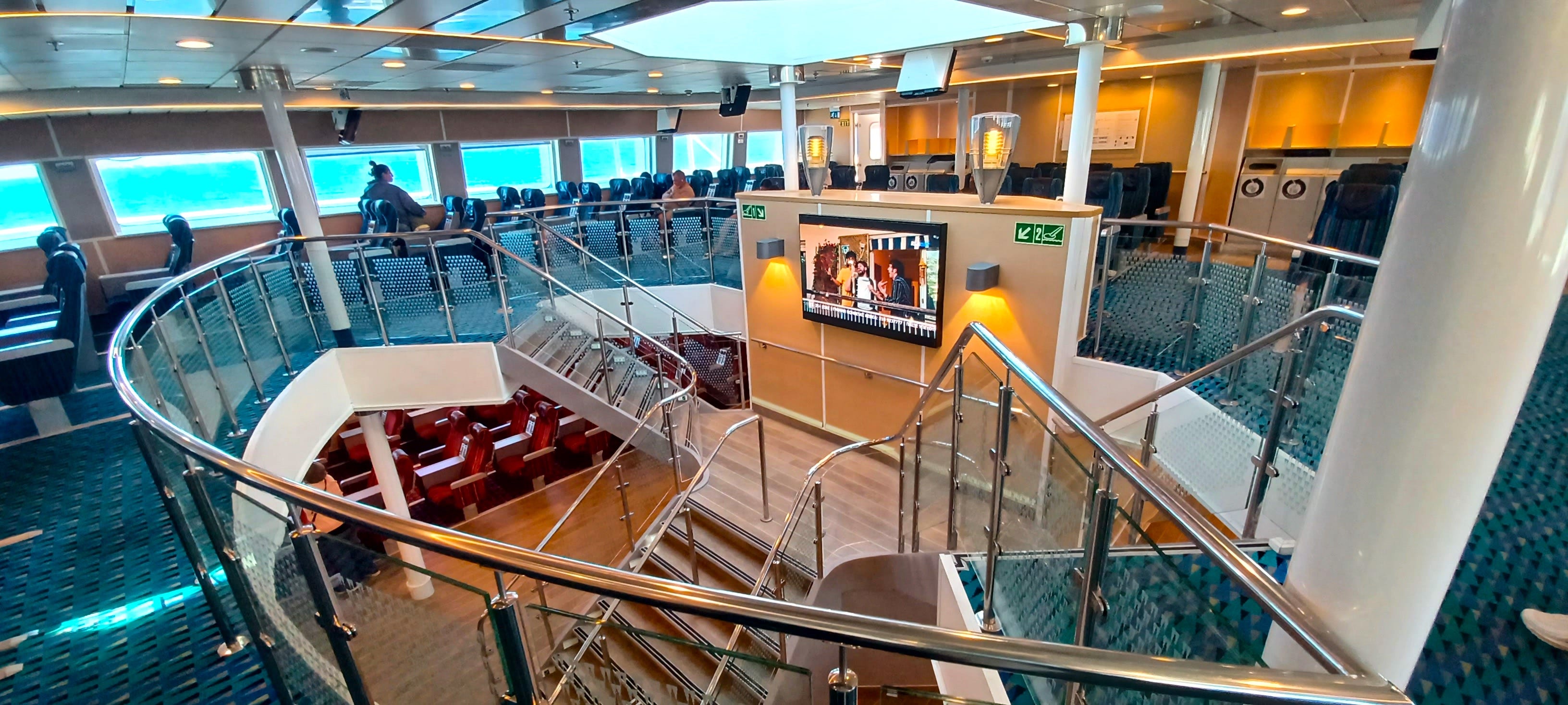
Economics aside, the experience of the “slow” boat is arguably superior. The high-speed catamarans are essentially airplanes on water. You are mostly confined to an aircraft-style seat, maybe staring at a TV screen…if there is an open deck area, it is usually a tiny, heavily secured aft-pen. And because it’s a Greek ferry, people are gonna smoke there. On a tiny fast-boat deck, the aerodynamics virtually guarantee you will inhale far more secondhand tobacco smoke than fresh sea spray.
On a grand Blue Star cruiser, however, you have room to roam. There are multiple salons, dining options and bars, and vast, sprawling open-air decks. You can find a quiet corner, watch the deep blue Aegean churn beneath the hull, and actually feel the sun. On a smaller catamaran, you are a passenger being delivered; on a grand Blue Star cruiser, you are an ocean voyager.
Then comes the geometry of the sea itself. The Meltemi winds of the Aegean do not care about your vacation itinerary. When the waves kick up, high-speed catamarans can ride the water like a mechanical bull. Traditional vessels have real mass below the waterline. They cut through swells with a rhythmic, predictable dignity that shields your stomach from the horrors of mal de mer.
Both options make multiple stops at various islands along the way, giving you that beautiful, episodic glimpse of whitewashed villages. But on the bigger boat, you’re enjoying it from a spacious deck, if you choose to exercise that option.
Why, finally, the mad rush to get to Santorini or Ios? Take a cue from the Greeks. Slow down, save your cash, order an iced frappé, and actually enjoy the journey. After all, the sea is the destination.