
This Stanford prof has harsh words for state of Greek demokracy (see what we did there?)
While elites celebrate fake success stories, Greece is quietly surrendering its global standing, a Greek-American Stan man says

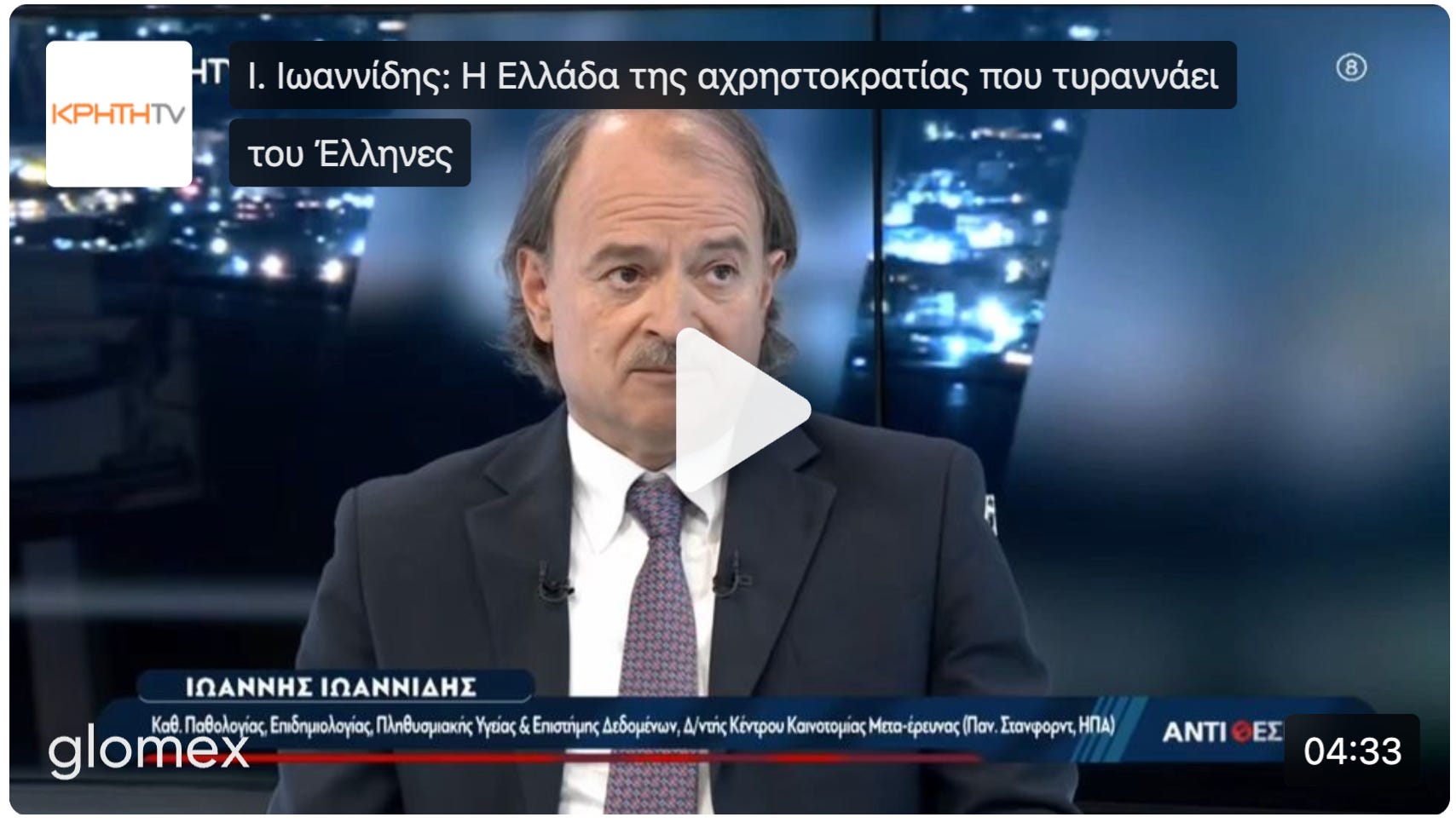
On paper, the narrative sold by Athens is one of triumph. Official press releases boast of economic turnarounds, digital revolutions, and international prestige. But look past the public relations shine, and a far bleaker reality comes into focus: Greece is not ascending—it is fading.
That was the stark warning delivered by Stanford University professor John P.A. Ioannidis in a blistering season-ending interview on Cretan TV’s Contrasts. One of the world’s most cited Greek scientists didn’t mince words. While the government cultivates a carefully staged image of modernization, critical international indicators show a nation in quiet, steady regression. On demographics, public health, institutional integrity, and brain drain, Greece isn’t moving forward.
“Greek democracy has gradually degenerated into a farce,” Ioannidis declared. “Democracy is an empty shirt—filled with falsifications, forgeries, injustices, and dishonor.”
The core tragedy of modern Greece isn’t just internal decay; it is a profound loss of ambition. A nation whose cultural and philosophical weight once shaped Western civilization is now content punching far below its weight, adrift in the currents of global geopolitics.
Technocratic Panaceas vs. Everyday Reality
Instead of tackling deep structural pathologies, Greek officials have embraced a simple playbook: rebrand basic governance as a “digital revolution.” Artificial intelligence and digitization are routinely peddled as magical panaceas that can solve the country’s economic and administrative woes. Yet, this blind faith ignores the fallout. Unchecked automation is poised to destroy far more quality jobs than it creates, hitting a workforce already depleted by years of economic stagnation and youth emigration.
While Athens rushes to digitize every facet of public life without debate, other European nations show a healthier skepticism. Britain, for instance, famously scrapped plans for mandatory digital IDs after intense pushback from a public that refused to yield its privacy to state databases. In Greece, however, technocratic mandates are quietly swallowed whole under the guise of progress, replacing meaningful political debate with slick user interfaces.
Geopolitical Sycophancy: Kissing the Ring
This passivity extends directly into foreign policy. Rather than leveraging its unique historical and strategic position to act as a sovereign mediator on the global stage, Greece’s leadership frequently opts for shallow posturing and eager deference to foreign political trends. High-level international relations have increasingly devolved into superficial photo ops with unseasoned, under-educated figures like Kimberly Guilfoyle—individuals whose public footprint has far more to do with dating powerful men and attending Paris fashion shows than actual diplomatic tradecraft. Rolling out the red carpet for political influencers is treated as grand statecraft, confusing proximity to foreign power with actual global influence.
Nothing illustrates this cringing dynamic better than prestigious gatherings like the Delphi Economic Forum. In an attempt to court favor with shifting political winds in the United States, foreign policy elites invited figures from the far-right outlet Breitbart to speak. What was staged as serious intellectual discourse felt to observers like an awkward attempt at ring-kissing—parading an outlet widely viewed as a sensationalist mockery in its home country as if it represented high-level diplomacy. When a nation’s elite acts like eager courtiers to foreign political factions, it signals to the world that its self-worth has hit rock bottom.
The Empty Shirt and the Human Cost
The real casualty of this posturing is the Greek people. A collapsing healthcare system, a demographic death spiral, and a continuous exodus of top talent leave the country structurally weaker every year. Ioannidis’s most poignant critique touched on the erosion of national identity itself—symbolized by the abandonment and trivialization of the Greek language, the very conduit of ancient and modern Greek thought.
“Even if I lose to all of them, I will continue to speak this language,” Ioannidis vowed, closing his interview on a note of defiant cultural preservation.
Greece cannot technocratize or PR-manage its way out of an existential crisis. Reclaiming its rightful place on the global stage requires more than digital portals and elite photo-ops. It demands restoring real substance to its democratic institutions, defending its human capital, and finding the courage to speak with an independent, sovereign voice once again. Until then, the empty shirt will only drift further into obscurity, the professor suggests.