

You're in Greece. Should you order Octopus?
Why Your Greek Salad is More Ethical Than Matt Damon’s Alleged Eight-Legged Lunch

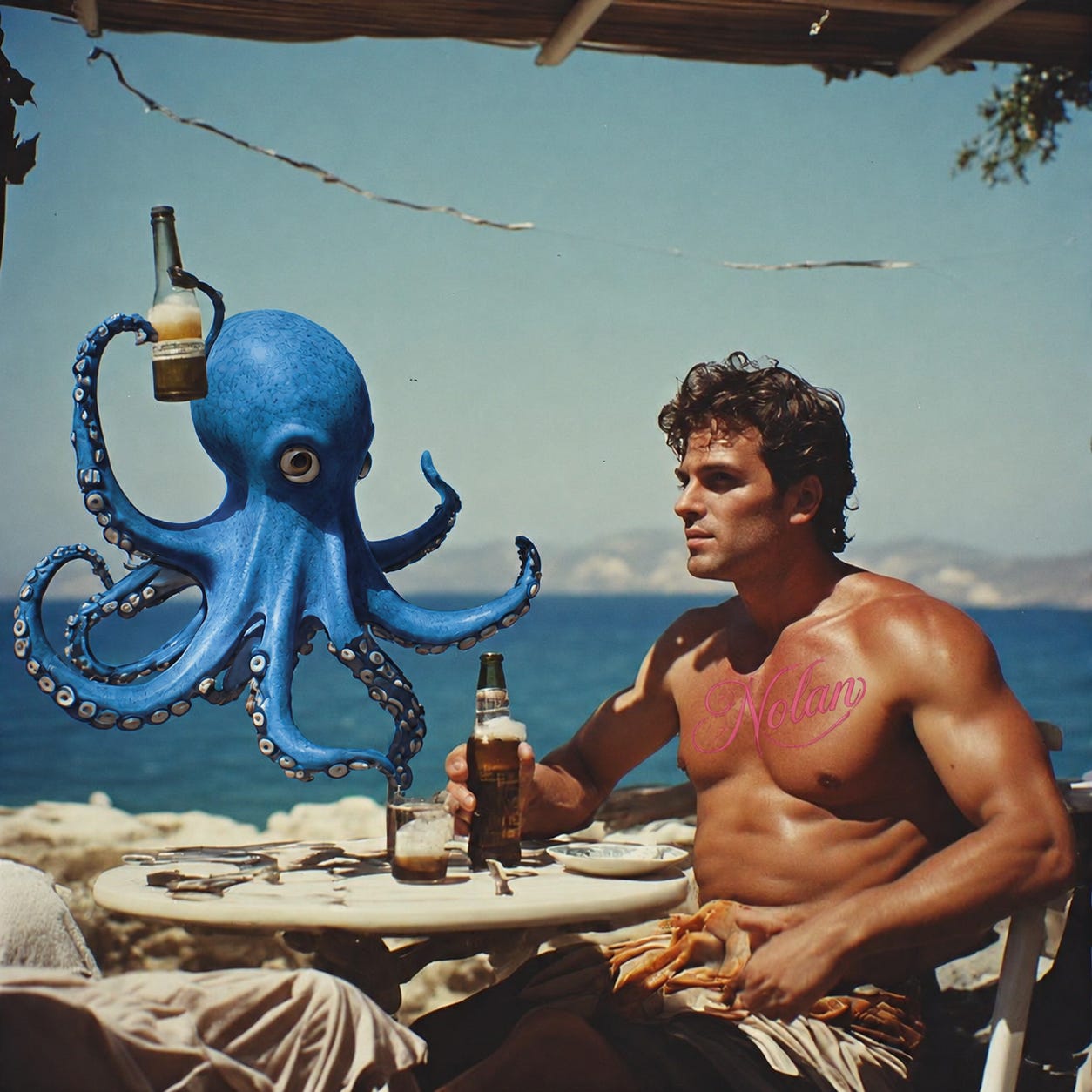
Ah, Greece. The sun-bleached whitewashed walls, the cerulean waters of the Aegean, and the ubiquitous sight of helpless octopuses strung up on clotheslines like wet laundry outside every oceanside taverna. It is a postcard-perfect image of culinary tradition that heavily populates the Instagram feeds of jet-setting elites and other poseurs, like the granddaughter of Diane von Furstenburg. But let’s be perfectly honest: ordering the grilled octopus just because you want to experience “authentic Mediterranean living” is an ethical disaster disguised by a squeeze of fresh lemon and a sprinkle of oregano.
We get it. You maybe saw the paparazzi photos of Matt Damon chowing down on charred tentacles while taking a break from filming The Odyssey. If Jason Bourne himself can devour an entire marine genius between takes, why shouldn’t you? But let’s look at the facts before we let Hollywood starlet-behavior dictate our environmental morals. Surviving on a fictional Martian landscape using potato starch does not actually grant Matt Damon a degree in marine biology, nor does it absolve him—or you—from the profound ethical bankruptcy of eating one of the smartest creatures in the sea.
The Intelligence Metric: Einstein vs. A Cucumber
Octopuses are not swimming vegetables. They are hyper-intelligent, sentient invertebrates capable of high-level problem-solving, navigating complex mazes, utilizing tools, and arguably experiencing boredom and existential dread…just like Scott Bessent! They possess a centralized brain and a nervous system distributed throughout their eight arms, effectively making them a walking, swimming computer. When you order an octopus, you are effectively ordering a creature that could probably hack your Wi-Fi if given enough time and a waterproof keyboard.
“To put it bluntly, a tomato does not have a soul, and a cucumber has never figured out how to unscrew a jar from the inside to escape captivity. Choosing the salad isn’t just a dietary choice; it’s an intelligence test for the human doing the ordering.”
Contrast this with the majestic components of a traditional Horiatiki—the humble Greek salad. The tomato has the intellectual capacity of, well, a tomato. It does not scream when sliced. The block of rich feta cheese is a byproduct of goats and sheep who spend their days happily vibing on rocky hillsides. The olives are shaken from ancient trees that actively clean the atmosphere. By choosing the salad, you satisfy your hunger without participating in the execution of a creature that exhibits distinct personality traits and long-term memory.
The Environmental Apocalypse on a Plate
Beyond the undeniable ethical dilemma of eating an animal that might be smarter than your average reality TV star, the environmental cost of satisfying your tentacle craving is astronomical. Global demand for octopus has caused local populations in the Mediterranean to go into freefall. Because octopuses are solitary creatures with relatively short lifespans, they do not respond well to industrial-scale commercial fishing. The traps and bottom trawls used to harvest them wreck the seafloor, turning fragile marine ecosystems into barren underwater deserts.
So, the next time you find yourself at a seaside taverna, ignore the siren song of the grill and the ghost of Matt Damon’s questionable culinary choices. Do the planet, your conscience, and the local marine life a favor. Order the Greek salad. It is crisp, it is refreshing, it pairs nicely with a glass of Greek wine and is authentically Mediterranean—and it leaves the ocean’s eight-legged geniuses exactly where they belong: swimming circles around us.
No octopuses were harmed in the writing of this article. The same cannot be said for the author’s faith in Hollywood’s environmental consistency.